





Introduction
Photography along the Cinque Terre trail is more than a string of postcard views: it’s a sensory journey where the light shifts constantly, sea air and citrus scents mingle, and every steep alley has a visual story to tell. Set on the Ligurian Riviera, the five towns—Monterosso al Mare, Vernazza, Corniglia, Manarola and Riomaggiore—cling to the rock like a coastal archipelago, with rainbow-hued houses, olive terraces and harbors that look made for photos. For photographers, whether hobbyists or pros, these villages serve up endless opportunities: environmental portraits, wide-angle panoramas, architectural details, dramatic backlighting and long exposures over the sea.
This complete guide zeroes in on the most unique photo spots along the trails (notably the Sentiero Azzurro, plus lesser-known paths) and gives you more than composition ideas: you’ll find essential practical details too—full place and monument names, exact addresses, entrance fees when relevant, opening hours and local tips to get the best shots. Whether you’re shooting in broad daylight, at golden hour or after sunset, you’ll find specific suggestions to capture the spirit of the Cinque Terre.
We cover high-altitude panoramas, shoreline anchor points, intimate alleys perfect for portraits, and monuments that take on a special light at particular hours. Each spot is described in an immersive way: how to get there, the best times for light, recommended camera settings and practical advice (parking, train access, Cinque Terre National Park tickets, amenities). This isn’t a dry checklist—it’s a visual route designed to help you turn a walk into a collection of memorable images.
Finally, visual markers

mark the article to help you picture scenes and plan your framing before you arrive. Whether you’re after iconic tourist shots or tucked-away details for a portfolio or social feed, this guide walks you step-by-step to make the most of the photographic riches along the Cinque Terre trail.
Panoramas and must-see viewpoints
Naturally, panoramas are what draw many photographers to the Cinque Terre. One of the most famous lookouts is the Manarola viewpoint, reached via Via Belvedere (Via Belvedere, 19017 Manarola, Riomaggiore, La Spezia, Italy). From this promontory you overlook the harbor and bay: pastel houses pop against the blue and make a perfect subject for a wide-angle panorama or a dramatic vertical low-angle shot. The best time to shoot is late afternoon into sunset, when the light grazes the facades and brings out the texture in the walls. Bring a tripod for long exposures and an ND filter if you want to smooth the sea in the foreground.
 Click here to book a photo session with a local photographer
Another must-see is the Passeggiata dei Santuari that leads to the Santuario di Nostra Signora di Soviore (Località Soviore, 19016 Monterosso al Mare SP, Italy). The coastal panorama from the heights of the sanctuary is wide and often less crowded than the shoreline viewpoints. The climb can require some effort, but the payoff is a clear view over Monterosso, its terraced vineyards and the curve of the bay. The sanctuary is a great spot for sunrise shots, especially when marine mist forms layered atmospheres. Entrance is generally free; check local notices for religious service times that might limit access.
Finally, the lookout above Vernazza near Castello Doria (Castello Doria, Piazza Castello, 19018 Vernazza SP, Italy) provides a perspective that blends heritage and nature. From there you can see the picturesque marina, the pebble beach and Vernazza’s pier, with colorful boats dotting the scene. The castle itself, perched on a promontory, often charges a small entrance fee (check local ticket booths; prices vary around €3–5 for tower access depending on the season). Shoot at golden hour for warm contrasts or early morning for cleaner scenes with fewer people.
Click here to book a sunset cruise with aperitif onboard
Villages in detail: top photo spots by town
Monterosso al Mare (Piazza Garibaldi, 19016 Monterosso al Mare SP, Italy): the largest of the Cinque Terre, Monterosso has long beaches, wider lanes and the old town (Fegina). For environmental portraits, Via Roma and Piazza Garibaldi provide colorful facades and local shopfronts as backgrounds. Fegina beach is ideal for sunrise beach scenes, with umbrellas and early fishermen. For religious architecture, the Church of San Giovanni Battista (Via Mazzini 5, 19016 Monterosso al Mare SP, Italy) has an interesting Gothic façade; entry is usually free but respect service times (often morning and late afternoon).
Click here to book a kayaking and snorkeling excursion

Vernazza (Piazza Marconi, 19018 Vernazza SP, Italy): unmissable, Vernazza is famous for its small beach and the Church of Santa Margherita d’Antiochia (Piazza Marconi, 19018 Vernazza SP, Italy). The seafront bell tower and jetty offer perfect backlit compositions. Head up to Castello Doria to vary your shots and capture the village-and-beach combo. Opening times: most shops open between 9 and 10am, while quiet hours ideal for photography are usually 7–9am. Local fishing boats can often be arranged for sunrise or sunset shots—a small tip in exchange for posing is common practice.
Click here to book a sunset cruise

Corniglia (Piazza San Pietro 1, 19018 Corniglia SP, Italy): perched above the sea and reached by 382 steps from the station or by a winding road, Corniglia offers vine terraces and the Church of San Pietro (Piazza San Pietro, 19018 Corniglia SP). Here, focus on details: wooden doors, framed windows and stone textures. The viewpoint from Piazza San Pietro gives a more distant perspective, ideal for mid-range focal lengths (35–85mm) and for capturing the calm of the vineyard landscapes.
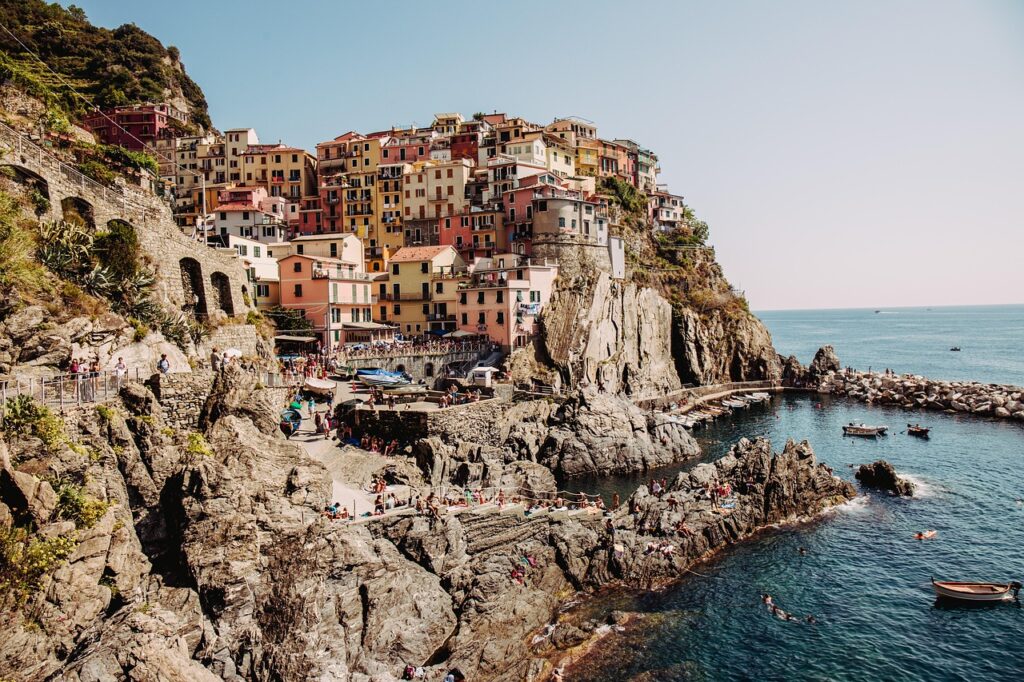
Manarola (Via Belvedere, 19017 Manarola SP, Italy): famous for its viewpoint and small harbor, Manarola is ideal for layered compositions using rocks, water and stacked houses. The small cliffside path known as Punta Bonfiglio offers angles that emphasize the contrast between the dark sea and bright facades. Bonus: a few meters from the harbor, the Via dell’Amore (when open) provides a romantic cliffside setting perfect for silhouettes and sunset portraits. Check access conditions—sections may be closed for repairs.
Click here to book a boat tour with snorkeling
Riomaggiore (Via Colombo, 19017 Riomaggiore SP, Italy): the easternmost village is very photogenic from Via Colombo and the marina. Houses rise almost vertically—play with lines and perspective. The small harbor and jetty create dynamic compositions with fishing boats and water reflections. For a unique angle, climb to the viewpoint near the Torre (Torre di Riomaggiore, Via San Giovanni Bosco, 19017 Riomaggiore SP, Italy) at dusk to capture the village lights switching on.

Sentiero Azzurro and other trails: angles and timing
The Sentiero Azzurro (Sentiero Azzurro, Cinque Terre National Park, starts at Monterosso al Mare) is the busiest coastal route and serves up spectacular shoreline views. Access is regulated by the Park Card (Cinque Terre Trekking Card). Indicative rates: about €7.50 per person for a one-day pass (prices vary seasonally); tickets are available at main access points or online via the Parco Nazionale delle Cinque Terre website. The trail is generally open daily, but sections can be closed for maintenance or weather—check the official Park site or station noticeboards before you set out.
Click here to book a panoramic hike from Levanto to Monterosso

Photographically, favor golden hour on the Sentiero Azzurro—the side light enhances rock fissures and the relief of terraces. A 24–70mm zoom is versatile for combining landscape and detail, while a 70–200mm telephoto helps isolate distant elements (clusters of houses, fishermen on a rocky outcrop). For long exposures, set up a tripod and shield it from the wind—the coast can be breezy and plant movement will show up in longer frames.
Beyond the Sentiero Azzurro, explore quieter tracks like the route to Santuario di Nostra Signora di Soviore (Località Soviore, 19016 Monterosso al Mare) or the agricultural paths winding between Vernazza and Corniglia. These trails offer views over vine terraces, perfect for documenting terraced viticulture (UNESCO). Late in the day, look for backlighting where vineyard rows create graphic lines—ideal for minimalist compositions.
Monuments, churches and architectural details to capture
The Cinque Terre’s churches and monuments make excellent historical subjects. Here are specific places not to miss, with addresses, opening notes and shooting tips:
- Chiesa di San Giovanni Battista – Via Mazzini 5, 19016 Monterosso al Mare SP, Italy. Hours: visits usually possible from 9:00 to 18:00; check local notices for services. Price: free entry (donations appreciated). Photography: 35–50mm focal length works well to capture interiors without heavy distortion, ISO 400–800 depending on light.
- Chiesa di Santa Margherita d’Antiochia – Piazza Marconi, 19018 Vernazza SP, Italy. Hours: open mornings and late afternoons; check local postings. Price: free. Photography: the seaside façade is ideal for backlit shots—use a polarizing filter to cut marine glare.
- Chiesa di San Pietro – Piazza San Pietro, 19018 Corniglia SP, Italy. Hours: variable by season; often open during the day. Price: free. Photography: stone and blue sky create strong contrasts—focus on architectural details (portals, capitals) with a macro or 50mm lens.
- Castello Doria – Piazza Castello, 19018 Vernazza SP, Italy. Hours: seasonal—check before you go. Price: often €3–5 for access to towers and walls. Photography: elevated vantage point perfect for panoramas; golden hour highly recommended.
- Torre di Riomaggiore – Via San Giovanni Bosco, 19017 Riomaggiore SP, Italy. Hours: check with the local municipal office. Price: variable. Photography: silhouettes at dusk, artificial lamp light against stone make compelling shots.
Local practical tip: respect opening times and religious services—churches are places of worship and some areas may be off-limits during ceremonies. Wear comfortable shoes if you plan to climb cobbled alleys for elevated angles; many monument accesses involve narrow stairways.

Technical and practical tips for photographing the trail
Recommended kit:
- Camera: APS-C or full-frame body depending on preference; in-body stabilization helps for long exposures.
- Lenses: 16–35mm wide-angle for panoramas, 24–70mm zoom for versatility, 70–200mm telephoto to isolate distant details and compress planes.
- Light but sturdy tripod: essential for sunsets and long exposures over the sea.
- Filters: polarizer to boost sea colors and cut reflections, ND filters for daytime long exposures.
- Extra memory cards and spare batteries: not all trails guarantee charging options.
Practical settings by situation:
- Sunrise: low ISO (100–200), aperture f/8–11 for depth of field, shutter speed adjusted with ND filter to shape water texture.
- Alley portraits: wide aperture (f/2.8–4) to isolate your subject and create soft bokeh against colorful facades.
- Long exposures of the sea: exposure times from 1 to 30 seconds depending on the desired effect; use tripod and remote shutter release.
Local tips:
- Transport: use the train (Cinque Terre Express) to hop between villages. Stations sit below the towns; avoid driving where possible—parking is limited and expensive.
- Cinque Terre Card (park): pick up the trekking card to access the Sentiero Azzurro and park services. Check prices and purchase points at stations or via the official park website.
- Follow the rules: do not pose on railway tracks or in protected areas; some zones are closed to protect terraces and for safety.
- Quiet times: early morning (6–9am) or late evening (8–10pm in high season) to dodge crowds and capture intimate atmospheres.
Click here to book a premium train tour of five villages

Conclusion
Shooting the Cinque Terre trail is an invitation to explore a wide range of compositions—from sweeping seascapes to intimate alleyway details, from stone textures to the graphic lines of terraced vineyards. By combining local knowledge (full place names, addresses, opening times and fees) with thoughtful technical prep (lenses, tripod, filters) and smart timing (sunrise, golden hour, off-peak hours), you’ll turn your visit into a series of authentic, memorable images. Keep a few simple rules in mind: respect places of worship and protected zones, buy the Cinque Terre Card when needed for official trail access, and favor the train to move between towns.
Each village has its photographic character: Monterosso for beach scenes and village life, Vernazza for harbor compositions, Corniglia for agricultural perspectives, Manarola for iconic viewpoints and Riomaggiore for vertical colors and bustling harbor energy. Monuments—churches, castles and towers—add historical depth and let you weave visual narratives around local traditions.
Finally, remember to watch before you press the shutter: light shifts quickly by the sea, fishermen, residents and shopkeepers bring life to scenes, and changing weather (sea mist, wind, dramatic clouds) creates unique opportunities. Pack extra memory cards, your gear and patience—on the Cinque Terre, every trail turn can reveal a frame worth keeping. Safe travels and happy shooting!